


The following article, by a correspondent embedded with the Army of the Cumberland’s Cavalry Corps, appeared on page four of the July 8, 1863 issue of The New York Herald. The entire issue is fascinating, as it covers the fall of Vicksburg, the retreat from Gettysburg, and Tullahoma. Nearly all of page four is devoted to the Tullahoma Campaign, which is often overlooked as compared to the other two campaigns.
MR. E.D. WESTFALL’S DESPATCHES
Headquarters, Reserve Corps
Army of the Cumberland
Shelbyville, Tenn., June 28, 1863
CAVALRY OPERATIONS
The corps of reliable gentlemen have been under a cloud since the movement of the army commenced, left Tuesday. I dislike to acknowledge that all my efforts to enlighten Herald readers in …


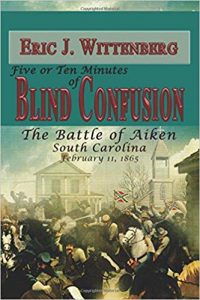 I am proud to announce the release of my newest title, Five or Ten Minutes of Blind Confusion: The Battle of Aiken, South Carolina, February 11, 1865. The short but ferocious cavalry battle at Aiken was the sole Confederate battlefield victory during Sherman’s 1865 Carolinas Campaign–it was one of the few Confederate battlefield victories in any theatre of the war in 1865–and had great strategic significance. Confederate commander Maj. Gen. Joseph Wheeler disobeyed orders to pursue Bvt. Maj. Gen. Judson Kilpatrick’s cavalry at Aiken, meaning that the defensive line of the Edisto River, south of Columbia, South Carolina, lacked sufficient manpower to hinder the advance of Maj. Gen. William T. Sherman’s armies on Columbia. Thus, while Aiken was a …
 Those of you who know me in person, or who have been long-time readers of this blog, know how important my battlefield preservation work is to me. While telling the stories of the Civil War is of crucial importance to me, the preservation of hallowed ground is, without question, the most important work that I do when it comes to my historical work. Thus, it is my honor to share this article from the May 26, 2018 issue of The Fredericksburg Free-Lance Star:
…Central Virginia Battlefields Trust adds three to board of directors
May 26, 2018The Central Virginia Battlefields Trust has elected three new members to its board of directors. Chris Mackowski, John McManus and Eric Wittenberg will
 On Monday, I received a call from old friend Clint Schemmer, who is the communications manager for the Civil War Trust. Clint called with some very important news.
For the past few years, the Trust has expanded its scope of coverage to include the Revolutionary War and the War of 1812. That work was being done by the Civil War Trust, and that just didn’t seem quite right. Clint called to tell me that the Trust has undergone a significant reorganization to accommodate these changes. He sent along the press release for it, which I reproduce for you below:
…NATIONAL HISTORIC PRESERVATION GROUP FORMS AMERICAN BATTLEFIELD TRUST
New umbrella organization will build upon success of Civil War Trust in
Dr. John Wyeth, who documented the exploits of Nathan Bedford Forrest’s cavalry in the latter portion of the Civil War, started out as a private in the 4th Alabama Cavalry of Maj. Gen. Joseph Wheeler’s corps. Wyeth was present at the June 27, 1863 Battle of Shelbyville, Tennessee, during the Tullahoma Campaign. Shelbyville was an overwhelming Union victory, where Col. Robert H. G. Minty’s single brigade, augmented by two additional regiments, shattered Wheeler’s command, routed it, and sent Wheeler himself flying headlong into the deep, rushing waters of the Duck River to escape capture.
Writing in 1898, Wyeth left this vivid description of the mounted fighting at Shelbyville. It’s too good of a description not to share:
…A cavalry fight
Here’s the next in my infrequent series of profiles of forgotten cavalrymen of the American Civil War.
George S. Acker was born near Rochester, New York on December 25, 1835. In 1839, his family relocated to Kalamazoo, Michigan, where he lived the rest of his life. “He was a bright and chivalrous young man,” recalled a local resident. He worked in a Kalamazoo hotel before the outbreak of the Civil War, where he was a “popular assistant.”
With the coming of war, he decided to enlist. He helped to recruit a company of the 1st Michigan Cavalry and was commissioned a captain. While serving in the 1st Michigan Cavalry, Acker “took an active part in the contests at Winchester, Orange …
William Douglas Hamilton was born in Lanarkshire, Scotland on May 24, 1832. He immigrated to the United States with his parents and two siblings six years later, and the family settled on a 200-acre farm near Newark in Licking County, Ohio. Two uncles had had settled in Ohio three years earlier, and parents followed their brothers to America, settling in a a Scottish enclave that developed along the National Road in Central Ohio.
As a youth, he worked on the farm and then taught school to earn his way through college and then law school. He graduated from Ohio Wesleyan College in Delaware, Ohio and from the Cincinnati Law School in 1859. He then established a law office in Zanesville …
It’s been a very long time since my last post, and even longer since my last Forgotten Cavalrymen profile. I’ve been working on the February 11, 1865 Battle of Aiken, South Carolina, which will spur several of these profiles. Here’s the first one, of Lt. Col. Matthew Van Buskirk of the 92nd Illinois Mounted Infantry.
Matthew Van Buskirk was born in Buckmantown, Clinton County, New York, on January 1, 1835. He was the son of Lorenzo Dow Van Buskirk and Louisa Van Buskirk, and had one brother, Albert, born March 20, 1841 (Albert Van Buskirk was killed in action at the Battle of Drury’s Bluff near Petersburg, Virginia on May 16, 1864). After completing his education, the young man relocated …
My old friend and fellow cavalry historian Bob O’Neill has started a new blog that I want to recommend to you. Bob is THE authority of the cavalry battles in the Loudoun Valley of Virginia during the Gettysburg, and that’s one of the focuses of the blog, which is called Small but Important Riots. That’s the title of Bob’s excellent but LONG out of print on these engagements from 1993. Bob’s working a new edition–truly excellent news for those of us interested in these fascinating engagements–and has also written a very good book on the cavalry division assigned to the defenses of Washington until just before the Battle of Gettysburg that I commend to you.
Bob’s new blog, which I …
From Philly.com today:
…Civil War Museum transfers collection to Gettysburg with Constitution Center exhibit planned
Updated: May 4, 2016 — 3:22 AM EDT
by Stephan Salisbury, Culture WriterThe homeless Civil War Museum of Philadelphia, steward of what scholars regard as one of the finest collections of Civil War materials anywhere but possessing no place to display them, reached an agreement Monday to transfer ownership of its roughly 3,000 artifacts to the Gettysburg Foundation, the private, nonprofit partner of the National Park Service.
At the same time, the National Constitution Center on Independence Mall has agreed to mount a permanent exhibition exploring the constitutional impact of the Civil War, using artifacts drawn from what is now the foundation’s Gettysburg collection.
Sponsors

 Back to top
 Blogs I like
- Andrew Duppstadt
- Andy Etman
- Blue Gray Daily
- Bob O'Neill
- Bottle Rocket Science
- Brooks Simpson
- Bruce Long
- Charlie Knight
- Civil Warriors
- Corey Meyer
- Craig Swain
- Damien Shiels
- Dave Powell
- David Woodbury
- Dimitri Rotov
- Drew Wagenhoffer
- Emerging Civil War Historians
- Harry Smeltzer
- J. D. Petruzzi
- Jack Dempsey
- Jim Miller
- Jim Rosebrock
- Jim Schmidt
- John Hoptak
- Kevin Levin
- Kraig McNutt
- Lee Hutch
- Mannie Gentile
- Mark Grimsley
- Matt Lively
- Michael Aubrecht
- Michael C. Hardy
- Michael Lynch
- Mike Block
- Mike Noirot
- Mysteries and Conundrums
- Rea Andrew Redd
- Richard J. Bell
- Richard McCormick
- Robert H. Moore, II
- Robert Redd
- Scott Mingus
- Scott Patchan
- Sean Heuvel
- Steve Light
- Susan Wittenberg
- Ted Savas
- TOCWOC
- Tom Clemens
- You Stink! blog
- Civil War Sites
- Central Ohio Civil War Roundtable
- Civil War Trust
- CWDG Online
- Dennis Morris
- J. David Petruzzi
- Ohio Civil War 150
- Ohio in the Civil War
- One Continuous Fight: The Retreat from Gettysburg and the Pursuit of Lee’s Army of Northern Virginia, July 4-14, 1863
- Pennsylvania in the Civil War
- Plenty of Blame to Go Around: Jeb Stuart’s Controversial Ride to Gettysburg
- Randy Drais
- Rush’s Lancers, also known as the Sixth Pennsylvania Cavalry
- The Books of Eric J. Wittenberg
- Wade Sokolosky
- West Virginia in the Civil War
- Woodbury Historical Tours
- Compilation Blogs
- Other Sites
- Our sponsors
- Publishers of Civil War History
- Popular Pages
- Archives