Today marks the Sesquicentennial of the Battle of Kelly’s Ford, fought March 17, 1863, along the banks of the Rappahannock River in Culpeper County, Virginia. Please click on the image to see a larger version of this contemporary depiction of the fighting at Kelly’s Ford that St. Patrick’s Day.
That day, Brig. Gen. William Woods Averell’s Second Cavalry Division of the Cavalry Corps of the Army of the Potomac forced its way across the Rappahannock at Kelly’s Ford and brought the Confederate cavalry brigade of Brig. Gen. Fitzhugh Lee to battle. The fight lasted for most of the day. First, Averell’s men had to force a crossing of the river, pushing through Confederate rifle pits. They then had to force their way through felled trees that blocked the road. Once they Union horse soldiers forced their way across the river and through the abatis, Averell then ordered his men to charge. Mounted charges met by mounted countercharges by Fitz Lee’s horsemen went back and forth for much of the afternoon. Maj. John Pelham, Jeb Stuart’s gifted chief of horse artillery, foolishly joined a charge by the 5th Virginia Cavalry near the Wheatley farm, and received a mortal wound when a Union artillery shell burst on a stone wall, spraying deadly shrapnel. One of those pieces of shrapnel took Pelham’s life.
Daniel Davis has written a nice account of the battle that appears over at Emerging Civil War. I recommend it to you.
Averell pushed the Confederate horsemen back a mile or two, and then he paused to dress his lines. The final charges too place on the property just preserved by the Civil War Trust. Incorrectly believing that the Confederate cavalry had received infantry reinforcements, and with his force alone and behind enemy lines, Averell broke off and withdrew from the battlefield, leaving it in Fitz Lee’s hands. By all measures, Kelly’s Ford was a Confederate victory. Lee’s troopers held the battlefield at the end of the day, and Averell failed to accomplish his strategic goal, which was to disperse the Confederate cavalry in Culpeper County. However, that victory cost the Confederacy the services of John Pelham.
For a larger version of Steve Stanley’s excellent battle map (which shows the recently preserved battlefield land in yellow), please click on the map. As always, I am grateful to the Civil War Trust for allowing me to borrow its extremely useful interpretive maps.
My friend Craig Swain has a post on his blog today about the commemoration of the battle that took place today, including some photos of the battlefield as it appears today. It includes photos of the new pullover and new interpretive markers that have just been placed on the land preserved by the Civil War Trust. Please check them out.
There are some interesting quotes by participants in the Battle of Kelly’s Ford that provide insight into the fierce fighting there. “A cavalry charge is a terrible thing. Almost before you can think, the shock of horse against horse, the clash of steel against steel, crack of pistols, yells of some poor lost one, as he lost his seat and went down under those iron shod hoofs that knew no mercy, or the shriek of some horse overturned and cut to pieces by his own kind,” recalled Pvt. William Henry Ware of the 3rd Virginia Cavalry. “It is Hell while it lasts, but when man meets his fellow man, face to face, foot to foot, knee to knee, and looks him in the eye, the rich red blood flows through his veins like liquid lightning. There is blood in his eye, Hell in his heart, and he is a different man from what he is in the time of peace.” One of Averell’s men left a parallel description. “It was like the coming together of two mighty railroad trains at full speed. The yelling of men, the clashing of sabers, a few empty saddles, a few wounded and dying, and the charge is over. One side or the other is victorious, perhaps, only for a few minutes, and then the contest is renewed,” observed Sgt. George Reeve of the 6th Ohio Cavalry. “A charge of this kind is over almost before one has time to think of the danger he is in.”
Moreover, the Battle of Kelly’s Ford proved to be a real turning point in the evolution of the Union cavalry. For the first time, the Federal horsemen stood and fought the very best that the Army of Northern Virginia’s Cavalry Division had to offer, and the Federals gave as good as they got. Lt. Joseph A. Chedell of the 1st Rhode Island, wrote that Kelly’s Ford was the “first real, and perhaps the most brilliant, cavalry fight of the whole war.” From that moment forward, the Union horsemen believed that they were the equals of Stuart’s vaunted troopers, and from that moment forward, the blueclad horse soldiers went into battle with confidence and skill. Just three months later, those same troopers–no longer commanded by Averell–fought Stuart’s troopers to a standstill on nearby Fleetwood Hill during the June 9, 1863 Battle of Brandy Station.
That evolution–and its implications for the rest of the Civil War in the east–make this day of brutal combat worth commemorating. Today, we pay tribute to the brave men of both sides who crossed sabers during the Battle of Kelly’s Ford.
For those interested in the upcoming Sesquicentennial of the Battle of Kelly’s Ford (fought on March 17, 1863), my friend and fellow BSF board member in exile Craig Swain is leading a commemoration of the battle next Sunday (St. Patrick’s Day), from 2:00-3:15. The commemoration will occur on the battlefield proper, at the time when the battle was taking place. The event is to both commemorate the battle, but also to dedicate a new interpretive spot on some of the ground preserved last year by the Civil War Trust.
Craig has further details on his blog. If you’re in the area, please check out this event!
While I’ve known about this for some time, it’s only just become a matter of public knowledge, and I’m excited about this preservation opportunity.
The Civil War Trust has announced a campaign to raise funds to pay for 964 acres of core battlefield land at Kelly’s Ford, near
Brandy Station. This represents almost 50% of the battlefield from the important March 17, 1863 cavalry battle between William Woods Averell and Fitz Lee’s troopers. The map shows where this particular parcel may be found. The land in yellow is the land in question. It was the scene of the most severe fighting of the battle. Click on the map to see a larger version of it.
With this large acquisition, combined with the significant portion of the battlefield owned by the Commonwealth of Virginia, nearly 75% of the entire battlefield will be safe. This is a rare and exciting preservation opportunity and one that I hope all of you will get behind.
It’s important to note that no river crossing saw more traffic during the Civil War than did Kelly’s Ford. Much of the Army of the Potomac crossed the Rappahannock River there on its way to Chancellorsville, there was an infantry fight there in November 1863, and two of the three divisions of the Army of the Potomac’s Cavalry Corps crossed there on its way to fight the Battle of Brandy Station on June 9, 1863. This was probably the most famous and most important river crossing of the war, and the opportunity to preserve it is a rare one indeed.
It bears noting that this piece of the battlefield falls squarely within the bailiwick of the Brandy Station Foundation, which proudly touts that it’s going to hold an event to commemorate the sesquicentennial of the Battle of Kelly’s Ford next March. However, the BSF did absolutely nothing whatsoever to help to arrange this deal or to help to raise awareness of it. Why? Because it’s got nothing to do with ghost hunting, relic hunting, or the Graffiti House (which are the things that the BSF bragged about in its 2011 annual report), and because President Joe McKinney and his board of appeasers have rendered the organization completely and entirely irrelevant. They’re just as irrelevant to this acquisition as they are to the ongoing efforts to acquire Fleetwood Hill–that is to say, wholly inconsequential. It is pathetic that the organization tasked with preserving the battlefield land in and around Brandy Station has been rendered so irrelevant that it probably had no idea that the Trust had made this deal before it was announced publicly on the CWT website today.
Because of that, all donations to preserve the Kelly’s Ford battlefield should be directed to the Civil War Trust and ONLY to the Civil War Trust. Send a message to McKinney and the Board of Appeasers: send them a copy of your donation check and let them know that if they were doing the job that they were sworn to do, that money would be coming to them and not to the Trust.
Thank you for your support for our efforts to save this important battlefield land.
I wanted to announce a number of upcoming events, in case anyone is interested.
First, this Saturday, April 9, 2011, I am one of the presenters at a conference being held at Hollins University in Roanoke, Virginia. The topic is “Railroads, Raids, and Ruins–Laying the tracks of destruction in Virginia’s Civil War”, and it focuses on precisely what it sounds like. The speakers are Professor Peter Coogan (Hollins), Chris Calkins, Gordon Hamilton, a special appearance by Dr. James I. “Bud” Robertson, and me. My friend Clark “Bud” Hall was also supposed to present, but some pressing personal business has forced Bud to cancel, which means that I’m going to cover his slot. My first talk–the one I was scheduled to do–is a study of Union cavalry raids on Virginia railroads, 1862-1865. The second one is titled “A Tale of Two Railroads: The Baltimore and Ohio and Virginia Central Railroads During the Civil War.” Click here for registration information.
Then, on Sunday, April 10, I will be signing books in Greencastle, PA at the kick-off of the Greencastle-Antrim Historical Society’s Sesquicentennial of the Civil War celebration. It’s a full weekend event, but I obviously can’t there before Sunday due to the conference at Hollins. For information about this event, click here. Other authors who will be signing include my fellow blogger Scott Mingus, Sr. and Dennis Frye.
On April 12, I am speaking to the Civil War Roundtable of Atlanta, Georgia. My topic will be Plenty of Blame to Go Around: Jeb Stuart’s Controversial Ride to Gettysburg. Click here for sign-up information.
On May 19, I am speaking to the Powhatan Civil War Roundtable in Powhatan, Virginia. The topic will be the same as my Atlanta talk. Click here for information regarding the meeting.
On June 11, I am leading a tour of about half of the sites associated with our book Plenty of Blame to Go Around for the First Defenders Civil War Roundtable from my hometown of Reading, Pennsylvania. Click here for registration information.
I will be in Williamsport, Maryland all day on Friday, July 8, 2011 and for just over half a day on Saturday for Retreat Through Williamsport, sponsored by the Town of Williamsport and the National Park Service Chesapeake and Ohio Canal unit. On Saturday at 1:00, I will be speaking on the retreat from Gettysburg, and I will be signing books all day Friday and on Saturday morning. Click here for information regarding the event. We have to head out after my talk, as we have a beach house reserved in Wilmington, NC for the next week.
On September 14, I am speaking to our own Central Ohio Civil War Roundtable on how Revolutionary War tactics affected Civil War tactics. That’s going to be a completely new talk for me that ties up two of my favorite topics. Click here for information about the meeting.
From September 23-25, I will be leading a tour of Central Virginia cavalry battlefields for Woodbury Historical Tours. Battlefields visited will be Kelly’s Ford, Brandy Station, and Trevilian Station. Registration is limited to 15 or so, and the first dozen get free copies of my book on the Battle of Brandy Station. The schedule and registration information can be obtained by clicking here.
And, although this is way in advance, it’s never too soon to promote one of my favorite events. I’ve been invited to be a presenter at the annual Middleburg Conference on Leadership in the Civil War this year again, for the fourth time. This event always features an impressive array of talent and benefits a great organization, the Mosby Area Heritage Association. This year’s conference is September 30-October 2, and the title is “The Conference on the Art of Command in the Civil War: Cavalry of the North and South”, and it features some first rate talent. Scroll down the page for the schedule and for information on registration. Here’s the schedule:
Friday, September 30
4:00 p.m. – 5:00 p.m. – Registration, Reception & Book Browsing
5:00 p.m. – 6:00 p.m. – Horace Mewborn, Behind Enemy Lines with Rangers and Comanche’s! John Mosby and Elijah White
6:15 p.m. -7:15 p.m. – Clark B. Hall, From Bull Run to Brandy Station: JEB Stuart and the Emergence of the Confederate Cavalry
Saturday, October 1
8:00 a.m. – Registration, Coffee & Snacks
8:30 a.m. – 9:30 a.m.- Robert O’Neill, Colonel Percy Wyndham, A Question of Loyalty
9:45 a.m. – 10:45 a.m. – Marshall Krolick, Riding for the Union – Recollections from the 8th Illinois Cavalry
11:00 a.m. – 12 noon – Robert Trout, In Pelham’s Shadow: the Commanders of the Stuart Horse Artillery after John Pelham
12 noon – 12:45 p.m. – Lunch
12:45p.m. – 1:45 p.m. – Bruce Venter, General Insubordination: Custer vs. Kilpatrick in the Third Cavalry Division
2:00 p.m. – 3:00 p.m. – Clark B. Hall, Redemption is at Hand! Emergence of the Federal Cavalry after the Battle of Brandy Station
3:15 p.m. – 4:15 p.m. – Eric Wittenberg, Plenty of Blame to Go Around: JEB Stuart’s Controversial Ride to Gettysburg
4:30 p.m. – 5:30 p.m. – Panel Discussion and Book Signing
6:15 p.m. – Cash Bar Opens at American Legion Hall
7:00 p.m. – Banquet Dinner
8:00 p.m. – JEB Stuart, IV, Jeb Stuart at West Point and in Federal Service Out West
Sunday, October 2
8:00 a.m. – Buses depart Middleburg for a tour of Brandy Station Battlefield (box lunches included)
5:00 p.m. – Buses return to Middleburg
This is going to be a good one, folks. Check it out.
That’s it for now. As always, I will continue to update my schedule of events as things go.
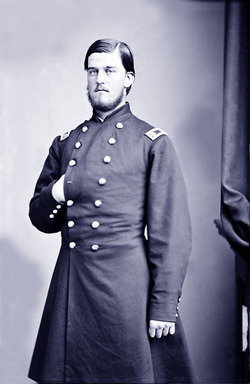
Jim Lamason went to the New Jersey State Archives for me to look for information on the role of the 1st New Jersey Cavalry’s role in the fighting on Brinkerhoff’s Ridge and East Cavalry Field at Gettysburg for the new edition of Protecting the Flank: The Battles for Brinkerhoff’s Ridge and East Cavalry Field, Battle of Gettysburg, July 2-3, 1863 being published by Savas Beatie later this spring. Unfortunately, Jim didn’t find anything useful there, but he did locate a report of the June 9, 1863 Battle of Brandy Station penned by Maj. Hugh Janeway, in temporary command of the regiment at the time, to the Governor of New Jersey. This report is different from the one in the Official Records, so I thought I would share it here. That’s Janeway in the photograph.
Headquarters 1st N.J. Cav.
Rappahannock Station
June 10, 1863To His Excellency, Joel Parker
Governor of the State of New JerseyGovernor,
I have the honor to report that the Regiment has been engaged in another very severe cavalry fight. On the 8th inst. the Division broke camp at Warrenton Junction and marched to Kelly’s Ford where we bivouacked for the night. The next day (the 9th inst.) at 3 a.m. we crossed the river and moved on Brandy Station. As is normal in times of danger we were in the advance. Meanwhile Genl Buford was fighting hard opposite Rappahannock Station. The object of our movement was to turn the right flank of the Rebels. Col. Wyndham was in command of the 2d Brigade composed of the 1st N. Jersey 1st Md. and the 1st Pa Cavalry and the command of our Regt. devolved upon Lt. Col. Brodrick. Capt. Yorke of Co. I had the advance guard composed of Cos. C & I– he moved his men so carefully that he captured every vidette in the road so that the first intimation that the enemy had of our being in their rear was by seeing the head of our column debouch from the woods.
Col Wyndham moved his troops with such celerity that we were upon them almost before they were aware of our vicinity. The fight lasted four hours and was a continual inception of the most brilliant charges ever made. Every officer behaved with the utmost bravery, coolness and it is impossible for men to behave better than did ours–they proved themselves well worthy of the State from which they come. More cannot be said in their praise.
Lt. Col. Brodrick and Major Shelmire were both wounded and taken while leading one of the numerous charges–accounts of the nature of their capture are so conflicting that I defer sending any statement regarding it till I learn something definite but that they both behaved with the greatest daring and gallantry there can be no question.
Capt. Sawyer Co. K and Lt. Crocker Co. H are also prisoners but not thought to be wounded. Capt. Lucas Co. F Capt. Maulsbury and Adjt Kitchen while in the thickest of the fray had their horses shot out under them–that of Adjt Kitchen fell dead carrying him along with it–his escape seems almost miraculous. When the order was given to retire our Regt covered the rear. I am told that Genl Gregg expressed the greatest satisfaction at the conduct of the Regt. Towards the close of the engagement Col. Wyndham recd a bullet wound in the calf of the leg but we are thankful to know that it will not prove dangerous–he kept the field for sometime after being hit but was finally obliged to give up–he goes to Washington today. We hope he will soon return as he can ill be spared from his command. He also paid the Regt the highest compliments for its steady and dashing charges.
The fight was hand to hand throughout. We had in the engagement four Field officers, 14 line officers and 281 enlisted men. Our loss in killed wounded and missing is at present 3 Field officers 2 line officers and 52 enlisted. This of itself speaks volumes for the bravery of the Regt. The morale of the Regt has been greatly benefitted by yesterday’s work and I am confident that the men will fight better now than ever. Major Beaumont will probably soon return from his present command to assume that of the Regt and will be able to collect further accounts of the capture and wounds of the missing officers than I am now able to do.
I have the honor to be Governor
Very respectfully
Your obdt servtHugh H. Janeway
Major Comdg 1st New Jersey Cavalry
Here are a few notes on this report.
Col. Sir Percy Wyndham, the regimental colonel, was in command of the brigade at the Battle of Brandy Station. He was, as Janeway pointed out, wounded in the leg in the melee, and he never commanded troops in the Army of the Potomac again. For my biographical sketch of Sir Percy, click here.
Lt. Col. Virgil Brodrick and Maj. John Shelmire were both mortally wounded in the melee, and both died on the field. Both are buried in the National Cemetery in Culpeper. Capt. Henry W. Sawyer was indeed badly wounded, which led to his capture, meaning that Janeway’s information was incorrect. Sawyer ended up being the center of quite a drama that is the subject of an article I’ve written that will appear in Civil War Times Illustrated later this year.
Thus, the 1st New Jersey Cavalry lost its colonel, lieutenant colonel, senior major, and a squadron commander that day. The regimental command structure was devastated in the fighting at Brandy Station. Janeway was killed in action less than a week before the Confederate surrender at Appomattox. It seems a shame to die so close to the end.
Thanks to Jim Lamason for getting this for me.
I have agreed to do a tour for David Woodbury’s Historical Tours company in September. The tour will focus on the Battles of Kelly’s Ford, Brandy Station, and Trevilian Station, and will be based in Culpeper, Virginia. I’ve done this tour previously, and it’s a good one. The cost of the tour is $270, which includes everything but lodging at the Best Western in Culpeper. For those interested in cavalry actions, this will be a good opportunity to learn about the evolution of the Union cavalry, as it evolved into one of the largest, most effective mounted force the world had ever seen. We will visit the sites of the two largest cavalry battles of the Eastern Theater of the Civil War in Brandy Station and Trevilian Station. The first twelve registrants will get an autographed copy of my new book on the Battle of Brandy Station as a premium for registering.
My friend Patrick Schroeder, the chief historian of the Appomattox Court House National Historical Park, will be leading an excellent tour for David of sites off the beaten track at Appomattox on June 4 and 5. I had a private version of that tour a few weeks ago, and it’s well worth the trip.
David’s doing a great job with these tours, and I commend them to you. Check them out.
One of the posters on my Civil War forum boards wrote a post today that indicated his interest in the Civil War is waning, and wondering if there was something wrong with him.
I responded. I made the point that I grow through intensive Civil War burnout regularly.
Keep in mind that in some ways, this is a second job for me. Consequently, I can’t even remember the last time that I just went to Gettysburg to go to Gettysburg and have fun, as opposed to going there for some event, to lead some tour, etc. Honestly, I don’t even remember when that was. I’ve been there twice so far this year, and on both instances, I ended up working–leading tours–nearly ever waking minute I was there. At some point, it ceases to be fun and becomes just another chore. As much as I loved seeing everyone at the CWDG Muster this spring, I worked the whole time I was there. It was neither relaxing nor was it fun in a lot of ways. It was work. And work is tiring.
Here’s an example of what I mean. Last year, I auctioned off a two-day tour of cavalry battlefield sites in Central Virginia as a fundraiser for battlefield preservation, and this June, it was time to deliver the goods. I drove the 6.5 hours to Culpeper on Friday, arriving there about 3 in the afternoon. I checked into the hotel and then spent two hours frantically driving around, taking GPS coordinates for a driving tour for my forthcoming Brandy Station book. I ate dinner alone at the hotel, and then spent a big chunk of the evening drafting a contract for a client. I spent the entire next day (a solid 8 hours) taking a dozen people around Kelly’s Ford and Brandy Station. I went to dinner with a friend that night, and then the next day, drive down to Trevilian Station, led the tour, then drove nearly 500 miles home, arriving about 8:30 PM. The next day, Monday, I had to get up and go to work. Sound relaxing? Hardly. Sound like fun? It was nice to have the camaraderie and to be on the fields, but no, fun is not a word that I would describe the experience. It was absolutely exhausting, I got paid nothing for it, and the expenses were out of my own pocket. And, just for good measure, I brought home a nasty case of poison ivy that took nearly a month to go away completely.
Likewise, in the last three years, I can think of one instance where I went to see a Civil War battlefield just for fun, and that was a one-day trip to Perryville with three friends in August of last year. In May 2008, I got a partial day visit to the Rev War battlefield at Guilford Court House. That’s it since 2006.
I get tired of it. I get frustrated with it. I get very burned out with it. I’m actually in one of those phases right now. I don’t feel like writing and I don’t feel like doing much digging. When I’m doing “pleasure reading”–as opposed to stuff that pertains to either my daytime job or to my research and writing–I almost never read Civil War stuff any more. I just finished an interesting book about the how the Israelis hunted down and captured Eichmann and then brought him back to Israel for trial. I finished that last week, so last night I started a book on the Franco-Prussian War of 1870.
What I really need is to take some time and just go visit a battlefield–without leading tours and without researching or doing something pertinent to my work–and simply enjoy it for the sake of enjoying it and for no other reason. That usually recharges my batteries and gets me back into the mode again. However, I’ve already been gone too much this year, I have another event coming up next month–another tour to lead–that will require me to be away from the office again, and I simply don’t have the time to be away right now, as my professional responsibilities will get in the way.
I miss the days when I could just go and enjoy being another visitor to a battlefield with no demands on my time or attention. I fear those days are gone forever, which I can accept. However, I really need to find some time to just go and enjoy being on a battlefield without any demands on my time to get my mojo back.
We’re home from our banzai run. We left on Friday, headed for my home town of Reading, PA. My mother’s 85th birthday is tomorrow–happy birthday, mom!–so we went in to celebrate the occasion a little early. Yesterday morning, we took off for Culpeper County, VA for the 20th anniversary picnic commemorating the founding of the Brandy Station Foundation. It had rained hard the whole time we were in Pennsylvania, and I was scared that the weather would not cooperate for the picnic. Fortunately, my fears turned out to be groundless, because it was a gorgeous day in central Virginia, about 80 degrees, not humid, and gentle breezes. The weather was just ideal.
The picnic was held on the grounds of Berry Hill Farm, which is south of the village of Brandy Station proper. The ford over Mountain Run where Col. Sir Percy Wyndham’s brigade of David M. Gregg’s Third Cavalry Division crossed while on the way to Fleetwood Hill is on the property. The house was destroyed by John Pope’s soldiers in 1862 and was rebuilt in 1866, and it’s a real show place.
More than 150 people attended, including all of the past presidents and most of the past and present board members of the BSF. Fellow blogger Craig Swain attended, so I finally got to meet him in person, and my friend Prof. Chris Stowe of the Army Command and General Staff College branch at Fort Lee in Petersburg, Virginia also made the trek and attended. As always, it was good to see and visit with Chris.
It was a well-done event that turned into an excellent fundraiser for the BSF’s good work. My role was to deliver a 15 minute talk on the history of the preservation of the Brandy Station, battlefield, a great but mostly unknown story that I intend to tell in book-length form. For the local newspaper’s coverage of the story, click here.
Eight of us–including Bud, Susan, me, Jens and Mary Tholand (Mary is a board member of the BSF), Mike and Caryn Block (Mike is also a board member), and old friend and cavalry nut Todd Kern–then had a wonderful meal at Pelham’s Pub at the Inn at Kelly’s Ford after the event, watching the horses and cows grazing in the fields by Kelly’s Ford that saw so much violence and bloodshed during the course of the war. Then, Susan and I spent the night in the General Hooker Suite at the Inn. We then drove home today, making a very brief stop at the Fort Necessity National Battlefield on the way home. We put 1000 miles on Susan’s car this weekend. No wonder I’m tired tonight….
Here are some images from the weekend for your perusal…

This is Clark B. “Bud” Hall, the guiding light behind the preservation of the battlefield at Brandy Station, addressing the crowd.

Me, addressing the crowd during my short speech.

Bud, BSF board member and fellow Phillies fan Mike Block, and me.

A great group of friends after the picnic: Todd Kern, Bud Hall, Kimberly Abe, me, Susan, Mike Block, and Caryn Block. A good time was had by all.

The house at Berry Hill Farm. It’s a beautiful home.

The main house at the Inn at Kelly’s Ford, taken by Susan this morning. The front portion of the house is the original house, which was there at the time of the March 17, 1863 Battle of Kelly’s Ford. I am advised that there is battle damage to the house from the many actions that occurred at Kelly’s Ford during the Civil War. The Inn itself is spectacular.
It was a great trip, and it was my honor and pleasure to help advance the cause of preserving a battlefield that means as much to me as this one does.
Yesterday finally ended three weeks of insanity.
On Friday morning, I hit the road for Virginia, headed for Culpeper. It’s nearly 435 miles each way, and it’s a LONG drive. I reached the Graffiti House at Brandy Station about 3:30, and then spent the next 90 minutes laying out a driving tour for my Brandy Station book, including shooting GPS coordinates for the stops on the tour (I ended up shooting 36 of them). I then went and checked into my hotel, had dinner in the hotel restaurant, and spent the evening watching the Pens beat the big, bad Red Wings to bring Lord Stanley’s Cup home to Pittsburgh. It was really pretty remarkable.
Last summer, I auctioned off a two-day tour as a fundraiser for battlefield preservation, and this weekend was time to deliver the goods. That’s why I made the trip. Saturday, with the help of Mike Block, who is a member of the board of trustees of the Brandy Station Foundation, who came along to help me lead the tour, we covered the Battles of Kelly’s Ford and Brandy Station in detail. We finished at the National Cemetery in Culpeper. This is now the second time that Mike and I have done this dog-and-pony show, and we really work together well. I really enjoy doing tours with him.
I was also fortunate enough to have Prof. Chris Stowe, who teaches at the Army Command and General Staff College’s branch campus at Fort Lee in Petersburg, VA, along. Chris is working on George Gordon Meade’s papers, and he is extremely knowledgeable. Finally, I had the opportunity to have Tim Ferry and Lance Williams along, and we had a great day. After a long, hot day, I then had dinner with old friend Melissa Delcour at a terrific Italian place in Culpeper called Luigi’s that I highly recommend.
The Brandy Station battlefield looks great, with the exception of the hideous McMansion that was built on the crest of Fleetwood Hill. We saw pretty much the whole field, although we didn’t hike out to the stone wall on the Cunningham farm. The ground was too soggy, and there would have been too many snakes and too many mosquitoes out there, and I made the command decision not to expose ourselves to it.
On Sunday, I took Chris, Tim, and the four fellows who won the tour to Trevilian Station. We drove the 45 miles down, toured the battlefield–none had been there previously–and then I took Tim and one of the others back to the Graffiti House, where they had left their cars. While I didn’t go off into the woods to look at the property–no time for that–I was able to confirm that the parcel of property that is going to be the subject of the CWPT’s next fundraising campaign is a key parcel because it connects the first and second days’ battlefields with a pristine parcel to make that link. It’s a pristine, 250-acre parcel that was part of the farm that was a major portion of the second day’s battlefield that was called the Gentry farm in 1864.
I then had to drive home. I left at 3:00, and got home at nearly 9:45. With the trip to Trevilians, I drove about 550 miles yesterday while making the banzai run. By the time I got home, I was completely exhausted, and I am still tired now, even after a decent night’s sleep in my own bed last night.
There’s nothing I love more than battlefield stomping, but after three straight weekends of leading tours and too much driving, I am worn out. I’m thrilled at the prospect of actually being home this weekend for a change. I also haven’t had a chance to see stuff I want to see because I’ve been leading tours non-stop. It would be nice to see something new while having someone else lead the tour for a change.
Anyway, that’s it for the banzai runs for now. I have a talk to the Western Pennsylvania Civil War Roundtable on Wednesday night, and then nothing again until October. It’s going to be a nice break. In the meantime, if any of my readers are in the Pittsburgh area, I hope you can make the talk on Wednesday night.
At 4:30 on Wednesday afternoon, as I was busily working on a draft of a complaint, my laptop suddenly locked up. When I tried to reboot it, it would not boot; the hard drive just made a clicking noise, and I came to the incredibly unhappy realization that I had suffered the same hard drive crash that my wife had suffered 13 days earlier. Apparently, the Fujitsu hard drives that Apple was using at the time (and Sony, too) are prone to zero-sector damages, which lead to crashes.
Of course, my whole life is on that computer. Most of the important stuff had a recent back-up done, but I still panicked. Anything that was sone since the back-up the week before would be lost, and there was a lot of work done during that period of time.
Luckily, everything will be recoverable. I should have it all back early next week. WE went and bought a new 2.5 inch drive for the laptop–Western Digital this time–and it was installed today. The old drive was 120GB, while the new one is 250GB, so I am better than doubling drive capacity. And the best part was that drives have come down so much that it cost me $79.99 for the new drive.
I am using our back-up laptop as I write this. It’s something like 6 years old, and it was the forebear to netbooks. Susan calls it the tiny laptop, for good reason. It weighs like 3 pounds and has a 10-inch screen. However, unlike netbooks, this is a full Pentium II processor running Windows XP, and it will do until I get my machine back Sunday when I get home.
All things considered, it could have been MUCH worse. However, as I told Susan yesterday, I feel like Linus from Peanuts does when he can’t find his security blanket.
I spent the afternoon today laying out the driving tour of the Brandy Station battlefield for my upcoming book, including adding GPS coordinates. I only addressed the publicly accessible portions of the battlefield; the Yew Ridge portion of the battlefield is entirely in private hands, and I have too much respect for the property owners to turn tourists loose on their property.
The battlefield is still beautiful, and I’m so grateful that I know it well enough to be able to lead tours there. I’m leading a tour of Kelly’s Ford and Brandy Station tomorrow and of Trevilian Station on Sunday before making the banzai run home Sunday.
Like I said, all things considered, it could be much, much worse.