William Woods Averell
Brigadier General
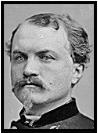 William
Woods Averell was born on November 5, 1832, in Cameron, New York. As a boy,
he worked as a drug clerk until his appointment to West Point in 1851. He
graduated in the lower third of the class of 1851, a classmate of Confederate
general Fitzhugh Lee.
William
Woods Averell was born on November 5, 1832, in Cameron, New York. As a boy,
he worked as a drug clerk until his appointment to West Point in 1851. He
graduated in the lower third of the class of 1851, a classmate of Confederate
general Fitzhugh Lee.
Averell's pre-war career in the army included duty at Jefferson Barracks in Missouri, a tour at the Cavalry School at the Carlisle Barracks, and two years of Indian fighting in the Far West. Averell was severely wounded in 1859, and was unfit for duty for a period of nearly two years as a result.
With the coming of war, he was appointed assistant adjutant general to General Andrew Porter, and participated in the First Battle of Bull Run. In the fall of 1861, he was appointed colonel of the 3rd Pennsylvania Cavalry, and soon became a brigade commander as a result of his administrative and training skills.
He commanded a brigade on the Peninsula, during the 1862 Maryland Campaign, and at Fredericksburg. In the interim, Averell received a promotion to brigadier general of volunteers on September 26, 1862. When the Army of the Potomac's Cavalry Corps was formed in the winter of 1863, Averell received command of the Second Division. He fought his old friend and classmate Fitz Lee in the March 17, 1863 Battle of Kelly's Ford. In a defensive battle, Averell fought his old friend to a draw and then withdrew from the field. While not a decisive victory, Kelly's Ford is considered to be the first significant victory for the Union cavalry in the Civil War.
Averell commanded his division during the Stoneman Raid, but for some reason, did not participate in the body of the raid. As a result, Maj. Gen. Joseph Hooker relieved him of command in May 1863. Averell assumed command of the cavalry forces of the Department of West Virginia, training them and forging them into a solid and dependable unit. His troopers conducted two daring winter raids, and then took the field for the spring campaign season in 1864. He was quite popular with his command.
When Maj. Gen. Philip H. Sheridan took command of the Middle Military District, Averell was entitled to command of the cavalry by virtue of seniority. However, Sheridan appointed Brig. Gen. Alfred T.A. Torbert as his chief of cavalry, offending Averell. When Averell displeased Sheridan in September 1864, Sheridan relieved him of command. Averell was crushed by this, and spent the rest of his life trying to justify his actions.
In spite of this slap in the face, Averell received brevets to brigadier and major general in the Regular Army. When he was not offered a commission as anything but a captain after the war, he resigned his commission in 1866. Perhaps Sheridan's enmity was a factor in this slight.
After the war, Averell served as U.S. consul general to Canada from 1866 to 1869, and then invented a number of devices that made him a wealthy man. He died on February 3, 1900.
Averell was a competent officer and an excellent trainer of men. However, he was a cautious officer, and his career suffered as a result. He did not deserve the shoddy treatment and the injustice that he suffered at Sheridan's hands.